HeavyPetal has a quick HOWTO on plugging shiitake logs. Her version includes the cheese wax step, with picture, which I didn’t bother with, so I highly recommend checking her post out. My guide to plugging a shiitake log is, of course, here.
Author Archives for brentn
Geotagging and Google Maps
This is way cool: Google Maps API now supports a wide array of geotagged sites. In the example given in the link, a properly geotagged Wikipedia article will display a link on Google Maps at that site. Very nice! I expect to see a lot of organizations tagging projects or sites of interest in this fashion. Think about the Nature Conservancy tagging potential new acquisitions or a local chamber of commerce highlighting attractions in their town this way.
Charity?
For a long time, I’ve struggled with Habitat for Humanity as a charity. On the face of it, the premise seems pretty worthy: help folks find affordable housing. Over the years, as I’ve thought and researched the subject, I’ve reached the conclusion that on the whole, Habitat for Humanity is likely making life worse for the people it is trying to help.
First and foremost, it appears that Habitat focuses on single family detached dwellings in suburban and exurban subdivisions. While this may not be true of all Habitat affiliates, it appears from my research on local Habitat affiliates and the national website to be generally true. I see this as a cruel prank of sorts on the future homeowner. At a time when it is becoming less and less affordable to live so far outside the city center and less desirable to become more dependent on a car for living, Habitat is offering to folks the false promise of economic independence and middle class lifestyle.
Many writers and publications have taken on this subject, including The Atlantic Monthly and Worldchanging, and the implications are pretty clear. The rising cost of living in suburbia are slowly making these areas unlivable for the people who could just afford to live there. People, like those who are being ‘helped’ by Habitat for Humanity will fare far worse, since they could not have afforded to live there at all.
The opportunity costs that Habitat incurs are high as well. By spending the money and using the land to build low-density housing, they prevent those resources from being used to build more efficient, high-density housing that could have a larger effect on the overall housing market in a region. If Habitat were to make it more affordable to build up the population density in former suburban areas, they could essentially drive the growth of livable, walkable neighborhoods, something that could possibly also make the difference in the cost-effectiveness of public transportation as well.
Further, Habitat focuses on traditionally-built homes. As far as I could tell, no Habitat affiliate makes any particular effort to build highly energy efficient homes. This is a further disservice to the people whom they are trying to help. I would have thought, in particular, that in areas with extremely depressed home prices (e.g. Detroit) Habitat would be working hard to buy and renovate marginal homes to make them more livable and efficient. I saw no such evidence of that on the Detroit affiliate’s web page, at least.
Considering these missed opportunities and disservices, I truly wonder how Habitat continues to attract donors and volunteers. Certainly, there are many opportunities for them in this economic downturn and housing crisis if they can change their model to address them. It may be more difficult for them to make these sorts of changes due to their affiliate structure, but by the same token, that structure might provide a way for particular affiliates to lead the way on their own.
Shiitake logs
Last year, I had to have a dying hickory in my yard cut down. While I paid to have most of the trunk hauled off, I still have a pile of the limb wood. I had decided a while back that I would plug these logs with shiitake spawn and make shiitake logs. Its best to do the plugging after the last hard frost, so I waited until yesterday to do the work.

I ordered my plug spawn from Fungi Perfecti, a neat company near Olympia, WA. They’ve got spawn for lots of different strains of mushrooms, but I love shiitakes and shiitakes love hardwoods. The spawn arrive in a little bag like the picture on the right. The spawn themselves are small dowels, about 1.5″ long, with a spiral groove cut into the side. You can clearly see the white mycelia from the shiitake in the groove. There is also some grain in the bag as well, which I surmise are how the dowels were inoculated.
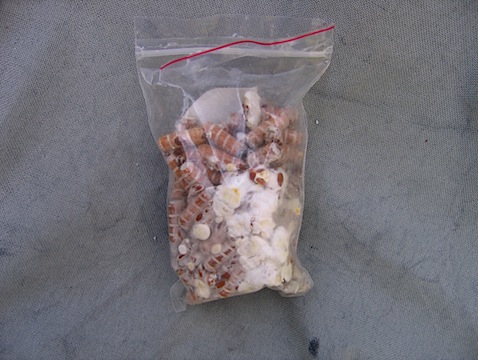
I had ordered my spawn about a month ago, so by the time I pulled the bag out, there was plenty of mycelial growth in the bag, which you can see in the picture on the left as the white matting around the dowels. According to the instructions, this is normal and probably wouldn’t have been so bad if I’d used the spawn more quickly. Fortunately, no mushrooms had begun to bud, so I didn’t have to pull those off.
Designing for a Green Society
I just read this piece by Alex Steffen on the WorldChanging blog and highly recommend it. The key quote from the piece, in my opinion, is this one:
[I]f we’re going to avert ecological destruction, we need to to not only do things differently, we need to do different things.
What he’s saying here is something that I’ve pointed out to my colleagues in the innovation community: sustainability is not about making things with less stuff, or that last longer, or that aren’t toxic, or even that can be infinitely cradle-to-cradle recycled. Sustainability requires us to invent things that make it possible to live more sustainably. If the things, the stuff, that we have and use make it easier to live sustainable lives than to not do so, then we will live sustainably.
Its not an easy problem to solve, for the same reason that truly groundbreaking innovation is not easy. It is pretty straightforward to imagine a novel solution for a market that already exists. It is much harder to invent a new market. I think that the kinds of products that will help people live sustainably are products for a market that doesn’t exist yet. Our business strategists don’t know how to value them, so our market analysts can’t compute a return on investment, so no investment is made. And truthfully, our scientists and engineers don’t always have the global perspective necessary to understand what types of solutions are necessary.
The point of Steffen’s article was to underline the importance of community in making these changes in our systems. I think that it is also important to understand the systems themselves. As we grow in our understanding the network of interactions and dependencies in our economy and our society, this understanding will allow us to break out of unsustainable patterns and replace them with ones that are equally understood, but are sustainable to the best of our knowledge. And because we’ll be building from a base of understanding, we’ll be able to look at them in a rational fashion 40 years from now when we understand the ways in which the new patterns are not sustainable.
It may be that at first, these more-sustainable patterns will be obvious. Things that folks like Steffen have been telling us for years, like community gardening, reducing sprawl, and increasing bike transport. But as with everything else, the low-hanging fruits will be quickly exhausted. At that point, progress will only be made by deeper understanding. It will be interesting to see how the tools for gaining that understanding develop.
Earthworms
When I started my small garden plot last year, I was appalled at the state of the soil. Looking back at the blog post, I didn’t say much about it, but I recall loosening the soil and discovering a thin layer of topsoil over greasy red clay. I worked some leaf compost into the plot and went from there. I also noticed that in digging up the roughly 80 square feet of garden, I found only a couple of earthworms.
At the end of the growing season last year, I seeded the plot with crimson clover as a green mulch and leaf mulched the swiss chard in hopes of having some of it survive the winter. This spring, when I started planting, I noticed that the soil seemed much healthier – black and a bit deeper, and nicely crumbly. Most excitingly, when I was digging up some of that weird 6-leaved running ground cover that had crept in from the edges, I found that I couldn’t lift a spade of soil without turning up at least one earthworm. Fantastic!
Dennett and modern positivism
Philosopher Daniel Dennett contributed an essay to the John Brockman edited collection What Are You Optimistic About? about the role that modern information technology might have on the growth of rationality and consequently, an increase in secularism and atheism. The essay, like most of the essays that Brockman solicits, is thought-provoking. Alas, the first thought it provoked for me was something along the lines of, “Clearly, Dennett has no faith in humanity’s ability to be stupid with greater speed and efficiency than before!”
The existence of technology will no more prevent religious fundamentalists of either the Muslim or Christian stripe from acting irrationally, anymore than the technology of the first Industrial Revolution caused an expansion of Enlightenment rationality as the 19th century positivists believed.
Google Spreadsheets and the Long Tail
I’ve been using Google Spreadsheets more recently to all the little one-pager list type spreadsheets that I make. When I noticed that they had added a notifications system, so that you can get an email when a collaborator updates a spreadsheet, or even a particular cell in the sheet, it sparked an idea. What if a cell could contain a short script, or a URL that points to a script on another server, that returned a number. The sheet could the update dynamically based on the result of the script.
This could be integrated with AdWords or Google Analytics, to return data from there that could feed custom analysis spreadsheets or could point to an internal database to use proprietary business data. I could also see data providers, e.g. the National Weather Service or Digg, providing statistics feeds that folks could slice and dice for their own purposes.
In a sense, this could be part of the long tail of the “super-cruncher”” phenomenon. Its hard to get good data to play with right now. A standard platform, or at least a standard access protocol, for raw numbers would open up opportunities to crowdsource data analysis.
Review and commentary on “Super Crunchers” by Ian Ayres
I recently read Ian Ayres’ excellent book, Super Crunchers. For folks who read and enjoyed Freakonomics, this book is a must-read, covering more cases where clever statistical analyses have uncovered interesting and useful results. The goal in writing the book, according to Ayres, was to encourage people to learn to think statistically. On the other side of the link is a discussion of some errors in experimental design, why their treatment in Ayres’ book frustrates me and why the average person should care.
More on the biofuel controversy
I posted an article earlier critiquing the media reaction to the recent reports on biofuels and land use management. Worldchanging has just posted a similar, fairly in-depth, critique as well. Their analysis goes more in depth into the specifics of each report, so I highly recommend it. What they do point out is that the Science articles are nuanced and that it was clear that the media in general either missed the nuance or ignored it.
 Brent Neal